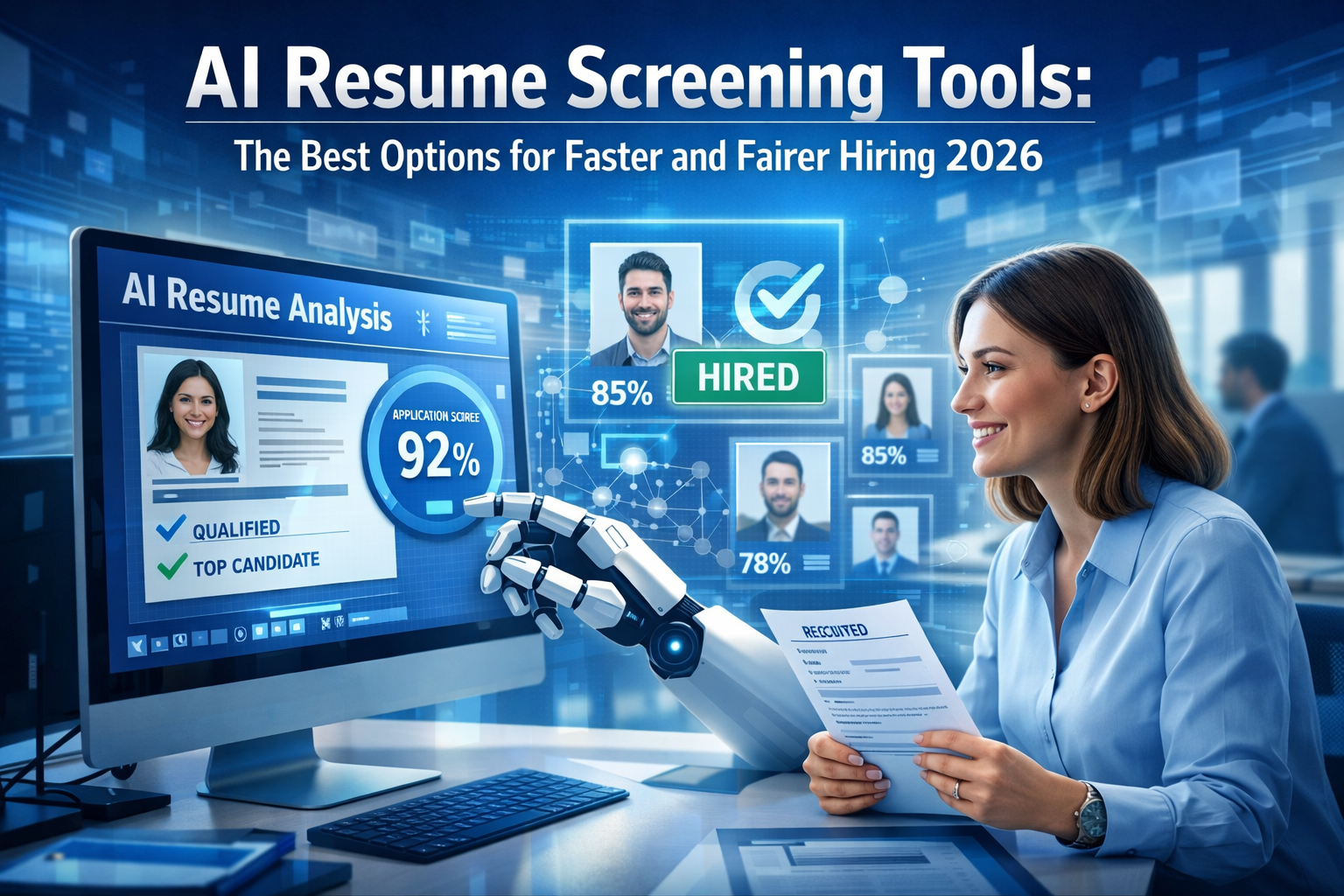
Every day, recruiters across the world face the same challenge: thousands of resumes flooding their inboxes, and only limited time to review them. Manual resume screening is time-consuming, error-prone, and often introduces unconscious bias. Enter AI resume screening tools—intelligent software that automatically evaluates resumes, identifies top candidates, and accelerates the hiring process while promoting fairness.
If you're tired of spending hours on resume reviews, missing qualified candidates, or wondering if your screening process is truly objective, this comprehensive guide to the best resume screening software solutions in 2026 is for you. We'll explore how automated resume screening works, what to look for in screening tools, and how to implement them effectively.
What Are AI Resume Screening Tools?
AI resume screening tools are software solutions that use artificial intelligence and machine learning to automatically parse, analyze, and rank resumes based on job requirements. Instead of manually reviewing each resume, these tools instantly evaluate hundreds or thousands of applications, identifying the most qualified candidates and flagging potential matches.
How Automated Resume Screening Works
- Resume Parsing: AI extracts key information from resumes (experience, skills, education, certifications) regardless of format.
- Skill Matching: The tool identifies matching skills, keywords, and qualifications against job requirements.
- Scoring & Ranking: Candidates are scored and ranked based on relevance and fit.
- Bias Detection: Advanced tools flag potential biases and ensure fair evaluation across all candidates.
- Instant Shortlisting: Top candidates are automatically flagged for recruiter review or moved to next-stage interviews.
Why Companies Need Resume Screening Tools in 2026
1. Scale Hiring Without Scaling HR Team Size
Popular job postings generate thousands of applications. Manual screening becomes impossible. With candidate screening tools, your existing team can manage 10x more applications without proportional headcount increases.
2. Reduce Time-to-Hire Dramatically
Resume screening software reduces application review from days to minutes. What previously took 2-3 weeks now happens in hours, enabling faster hiring cycles and competitive advantage in talent acquisition.
3. Improve Hire Quality
Automated systems evaluate candidates consistently using the same criteria, reducing the chances of overlooking qualified candidates or advancing unqualified ones. Learn more about comprehensive candidate screening methodologies that combine multiple evaluation approaches.
4. Eliminate Bias in Initial Screening
Traditional screening often introduces unconscious bias based on education institutions, names, or employment gaps. AI screening tools evaluate purely on skills and experience, supporting diversity and inclusion goals.
5. Reduce Recruitment Costs
Fewer hours spent on manual screening means lower recruitment costs. Additionally, better candidate matching reduces bad hires and costly replacement hiring.
Top AI Resume Screening Tools for 2026
1. Easy Hire Tool - Intelligent Candidate Screening
Features: AI-powered resume screening, skill matching, bias detection, free candidate avatar tool, multilingual support, no credit card required.
Best For: Startups, SMBs, and enterprises looking for affordable, transparent screening solutions.
Key Advantage: 100% free with no hidden fees, making it ideal for budget-conscious teams. The platform prioritizes user experience and accessibility without compromising AI capabilities.
2. Lever - ATS with Integrated Screening
Features: Resume parsing, skill matching, pipeline management, interview scheduling, integrations with HR tools.
Best For: Growth-stage companies needing full ATS functionality with screening capabilities.
3. LinkedIn Recruiter - Built-in Screening
Features: Resume review recommendations, candidate suggestions, InMail capabilities, extensive candidate database.
Best For: Companies with substantial recruitment budgets already using LinkedIn as their sourcing channel.
4. Greenhouse - Enterprise-Grade Screening
Features: Advanced resume screening, custom scorecard creation, detailed analytics, integration ecosystem.
Best For: Large enterprises requiring customized, scalable screening with extensive reporting.
5. Bullhorn - Staffing & Recruiting Specialist
Features: Automated resume screening, candidate analytics, mobile-first design, CRM capabilities.
Best For: Staffing agencies and recruitment firms managing high-volume hiring.
Key Features to Look for in Resume Screening Software
Accuracy & Consistency
The screening tool should accurately identify qualified candidates and maintain consistent evaluation criteria across all applications. Test accuracy rates before committing to any platform.
Bias Detection & Fairness
Look for tools that actively detect and prevent bias. The screening process should evaluate candidates on skills and qualifications, not demographic characteristics.
Integration Capabilities
Your screening tool should integrate seamlessly with your ATS, HRMS, email systems, and other recruitment tools. Seamless data flow reduces manual work and errors.
Customization Options
Different roles have different requirements. Look for solutions allowing customized screening criteria, weightings, and scoring thresholds for specific positions.
Multilingual Support
If hiring globally or in multilingual markets, ensure the tool supports resume parsing in relevant languages.
Transparency & Explainability
You should understand why candidates were ranked as they were. Look for tools providing transparent reasoning for their screening decisions.
Data Security & Compliance
Ensure the tool complies with GDPR, CCPA, and local data protection regulations. Candidate data security should be a top priority.
How to Implement AI Resume Screening Successfully
Step 1: Define Screening Criteria
Clearly identify must-have skills, preferred qualifications, educational requirements, and experience levels. Detail what makes an ideal candidate for the specific role.
Step 2: Set Up the Tool Correctly
Configure the screening tool with your defined criteria. Experiment with different weightings to optimize candidate matching accuracy.
Step 3: Test and Validate
Run screening on a test batch of resumes. Compare tool recommendations against human recruiter assessment. Refine settings until accuracy is satisfactory.
Step 4: Train Your Team
Ensure recruiters understand how to interpret screening results, override recommendations when appropriate, and use tool insights for better decision-making.
Step 5: Monitor and Optimize
Continuously monitor metrics like candidate quality, time-to-hire, offer acceptance rates, and new hire performance. Use insights to refine screening criteria.
Addressing Common Concerns About AI Resume Screening
Concern: Will AI Eliminate Human Judgment?
No. AI handles high-volume, low-judgment tasks (comparing resumes to requirements). Humans remain essential for assessing cultural fit, soft skills, and making final decisions. The best approach: AI handles screening, humans handle strategy.
Concern: Could AI Introduce Different Types of Bias?
Possible, but well-designed tools actively prevent this. Modern resume screening tools are trained on diverse datasets, monitored for bias, and can be configured to ignore bias-prone factors. Transparency in AI decision-making is critical.
Concern: What About Candidates Without Traditional Resumes?
Automated resume screening tools increasingly support alternative formats—portfolios, GitHub profiles, certifications, and skills assessments. Some solutions complement screening with alternative evaluation methods.
Concern: Is Implementing Complex?
Modern resumé screening platforms prioritize ease of implementation. Many are plug-and-play, integrating with existing systems in hours rather than months. Learning curves have shortened significantly.
AI Resume Screening vs. Traditional Screening: Impact Comparison
| Metric | Traditional Screening | AI Resume Screening |
|---|---|---|
| Time per 1,000 resumes | 40-60 hours | 15-30 minutes |
| Consistency | Variable (human fatigue, bias) | Consistent across all applications |
| Cost per hire | $3,000-$8,000 | $500-$2,000 |
| Candidate Quality | Good but inconsistent | Improved & consistent |
| Bias Risk | High (unconscious bias) | Low (when designed well) |
Future of AI Resume Screening
The resume screening landscape continues evolving rapidly. Expect to see:
- Video Resume Analysis: AI analyzing tone, body language, and communication in video applications.
- Skill Assessment Integration: Combining screening with automated skills tests for instant validation.
- Prediction Modeling: AI predicting not just fit, but long-term success and retention likelihood.
- Continuous Learning: AI systems improving accuracy over time by learning from hiring outcomes.
- Blockchain Verification: Cryptographic credential verification eliminating resume fraud.
- Expanded Multilingual Support: Better parsing and evaluation across more languages and resume formats.
Frequently Asked Questions
1. How accurate are AI resume screening tools?
Modern tools typically achieve 85-95% accuracy when properly configured. Accuracy depends on how well screening criteria are defined, quality of training data, and ongoing optimization.
2. Can I use resume screening tools for executive roles?
Yes, but with caveats. For executive positions, automated screening works best alongside human judgment. The tool can filter for basic requirements, but assessing leadership quality, strategic thinking, and cultural fit requires human expertise.
3. What formats do resume screening tools support?
Most modern tools support PDF, Word, plain text, and increasingly LinkedIn profiles. Some even support video resumes and portfolio links. Check specific tool capabilities for your needs.
4. How long does it take to implement a resume screening tool?
Implementation typically takes 1-4 weeks depending on complexity. Setup includes defining criteria, integrating with existing systems, testing, and team training. Many vendors offer implementation support.
5. Are resume screening tools compliant with hiring laws?
Reputable tools are designed to comply with GDPR, CCPA, EEOC guidelines, and employment discrimination laws. However, responsibility also falls on the organization to configure the tool fairly and monitor for bias.
6. Can resume screening tools handle international candidates?
Yes. Many global candidates submit resumes in multiple languages. Modern tools support multilingual resume parsing and international credential evaluation, essential for global hiring.
7. Will resume screening replace recruiters?
No. Resume screening automation replaces routine tasks, freeing recruiters for relationship-building, stakeholder engagement, and strategic hiring decisions. Recruiters become more valuable, not less.
8. How do I measure ROI from resume screening tools?
Track metrics like time-to-hire, cost-per-hire, quality of hire, candidate satisfaction, and time spent on screening. Compare before/after implementation to calculate ROI.
9. What's the cost of resume screening tools?
Costs vary widely: free solutions like Easy Hire Tool, $500-$5,000/month for mid-market tools, and custom enterprise solutions with pricing negotiated based on volume. Consider ROI when evaluating cost.
10. How often should I update my screening criteria?
Review and update criteria quarterly or when hiring needs change. Monitor new hire performance data to identify if screening criteria are accurately predicting success.
Making the Right Choice for Your Organization
Selecting the right AI resume screening tool depends on several factors:
- Volume: High-volume hiring justifies investment in advanced tools.
- Budget: From free to enterprise solutions, options exist for all budgets.
- Integration Needs: Ensure compatibility with your existing tech stack.
- Industry Requirements: Specialized industries may need specialized solutions.
- Global Scope: International hiring requires multilingual capabilities.
Start with a free or trial version to evaluate tool capabilities before committing. Test with real job postings and resume samples to ensure accuracy and fit with your hiring process.
Getting Started with AI Resume Screening Today
Resume screening software has evolved from a nice-to-have to an essential tool for competitive hiring in 2026. Whether you're processing 100 or 100,000 applications, automated screening accelerates decisions, improves quality, and promotes fairness in your hiring process.
The question isn't whether to implement automated resume screening—it's which solution is right for your organization. Start exploring today and join thousands of companies already experiencing the benefits of intelligent candidate screening tools.
Ready to Transform Your Screening Process?
Try Easy Hire Tool's intelligent candidate screening platform today. 100% free, no credit card required, no hidden fees.